

Ayurveda and AI: How Ancient Wisdom and Modern Tech Are Creating the Future of Wellness
In our fast-paced world, we’re flooded with quick-fix “biohacks” and conflicting health advice. We track our steps, try the latest diets, and optimize our schedules, yet many of us still feel disconnected, stressed, and out of balance. What if the key to true, lasting wellness isn’t a brand-new trend, but 5,000-year-old wisdom?
This is the power of Ayurveda, the ancient Indian “science of life.” But what happens when this profound knowledge meets the most powerful technology of today? You get a wellness revolution.
At Zupimars, we are at the center of this transformation. We believe the future of health isn’t about choosing between ancient tradition and modern science—it’s about blending them. This is how we’re using cutting-edge Artificial Intelligence (AI) to unlock and amplify the timeless principles of Ayurveda for your modern life.
What is Ayurveda? (It’s Not Just Herbs)
Before we look forward, let’s look back. Ayurveda isn’t just a collection of remedies; it’s one of the world’s oldest holistic healing systems. Its core belief is that health is a dynamic state of balance between your body, mind, spirit, and environment.
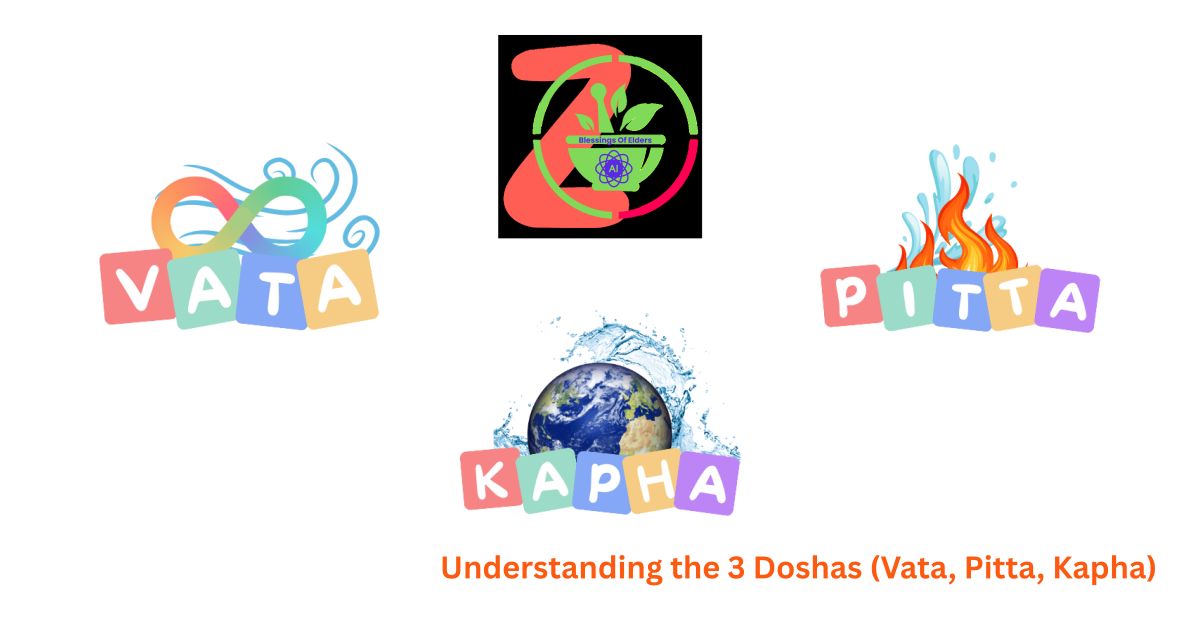
It all starts with the three Doshas, which are the fundamental life energies we all possess, made from five elements (Space, Air, Fire, Water, and Earth).
The 3 Doshas: Your Unique Energy Blueprint
- Vata (Space + Air): The energy of movement. Vata governs your breathing, blood flow, and nervous system. In balance, you’re creative and vibrant. Out of balance, you might feel anxious, scattered, or have dry skin and poor sleep.
- Pitta (Fire + Water): The energy of digestion and metabolism. Pitta oversees how you digest food and process thoughts. In balance, you’re intelligent, focused, and a strong leader. Out of balance, you may experience anger, inflammation, or acidity.
- Kapha (Earth + Water): The energy of structure and lubrication. Kapha provides your physical form, governs immunity, and keeps you grounded. In balance, you’re calm, strong, and stable. Out of balance, you might feel lethargic, gain weight, or experience congestion.
Your Prakriti: The Original Personalized Medicine
Every person has a unique combination of these three doshas, known as their Prakriti, or constitution. This is your personal blueprint for health.
This is why one-size-fits-all diets and wellness trends fail. A diet that nourishes a Kapha type might completely overwhelm a Vata type. Ayurveda understands this bio-individuality—a concept that modern science is only now catching up with. The goal isn’t to change your Prakriti, but to understand it and bring it back into balance.
Is Ayurveda Scientific? Why It’s More Relevant Than Ever
While its roots are ancient, its benefits are tangible and increasingly backed by modern research. Ayurveda’s holistic approach saw the body as an interconnected system long before modern science did.
Agni and Ama: The Gut Health Connection
For millennia, Ayurveda has emphasized the importance of Agni, or the “digestive fire.” A strong Agni allows you to efficiently digest food, absorb nutrients, and eliminate waste. A weak Agni leads to the formation of Ama—a toxic residue that Ayurveda views as the root cause of many diseases.
Today, modern science validates this through the lens of **gut health**. We now know the gut microbiome is a cornerstone of our overall health, influencing everything from our immune system to our mood. Ayurvedic practices—like eating whole foods for your dosha and using digestive spices—are proven methods to enhance gut flora and reduce inflammation.
The Mind-Body Link (Before it Was a Trend)
Ayurveda has never separated the mind and the body. It has always taught that emotional stress (like an imbalanced Vata) directly impacts your physical health, especially digestion. Science now calls this the **”gut-brain axis.”**
This is why Ayurvedic adaptogenic herbs, such as Ashwagandha, are now so widely respected. They are clinically studied for their ability to help the body manage cortisol (the stress hormone), reduce anxiety, and improve emotional resilience—something Ayurvedic practitioners have known for centuries.
The Zupimars Leap: Where Tradition Meets AI
Understanding Ayurveda is the first step. Applying it effectively in our busy, modern lives is the real challenge. This is where Zupimars serves as the essential bridge.
We don’t just sell products; we curate wellness solutions. Our philosophy is to Respect Tradition and Drive Innovation. But how do we ensure our formulas are not just authentic, but truly effective?
How We Use AI to Craft Superior Wellness
This is what truly sets Zupimars apart. We leverage the power of Artificial Intelligence to achieve a level of precision that was previously impossible.
- Hyper-Synergy Analysis: Our AI can analyze thousands of peer-reviewed scientific studies and ancient Ayurvedic texts in seconds. It identifies not just which ingredients work, but which combinations create a powerful synergistic effect, where the whole becomes greater than the sum of its parts.
- Bioavailability Optimization: An ingredient is only useful if your body can absorb it. Our AI models analyze molecular structures to predict and enhance absorption pathways. This ensures we use the most bioavailable form of each nutrient, so you get the maximum benefit from every single dose.
This AI-driven approach allows us to create products that are rooted in ancient wisdom but are the most scientifically advanced solutions on the market.
A Practical Guide to Your Modern Ayurvedic Day
Incorporating Ayurveda into your life doesn’t require a complete overhaul. It’s about small, mindful shifts. Here’s a simple framework, enhanced by Zupimars.
Morning (Kapha Time: 6 a.m. – 10 a.m.)
- Ayurvedic Practice: Wake with the sun, scrape your tongue to remove Ama, and drink a glass of warm water to stimulate your Agni.
- Zupimars Integration: Support your metabolism and gently awaken your digestive system with an energizing blend of herbs like ginger and trikatu.
Midday (Pitta Time: 10 a.m. – 2 p.m.)
- Ayurvedic Practice: Make lunch your largest meal of the day. This is when your digestive fire (Agni) is strongest. Eat mindfully, away from screens.
- Zupimars Integration: Support your body’s ability to break down food and absorb nutrients with a digestive enzyme formula to prevent that post-lunch slump.
Evening (Vata & Kapha Time: 6 p.m. – 10 p.m.)
- Ayurvedic Practice: Eat a light, warm dinner. Disconnect from screens at least an hour before bed to allow your mind to prepare for sleep.
- Zupimars Integration: This is when a racing (Vata) mind can disrupt sleep. Calm the nervous system with a grounding formula. For instance, our RelaxTagara, featuring Ashwagandha, is designed to quiet a racing mind and promote deep, restorative sleep.
Your Wellness Journey: Ancient and Future-Proof
The path to vibrant health isn’t about choosing between ancient tradition and modern science. It’s about integrating them.
Ayurveda provides the profound, personalized framework for understanding your unique body. Zupimars provides the precision to apply that wisdom with unparalleled effectiveness. Your wellness journey is uniquely yours, but you don’t have to walk it alone.
Ready to see what AI-powered Ayurveda can do for you? Explore our Zupimars solutions and find your balance today.